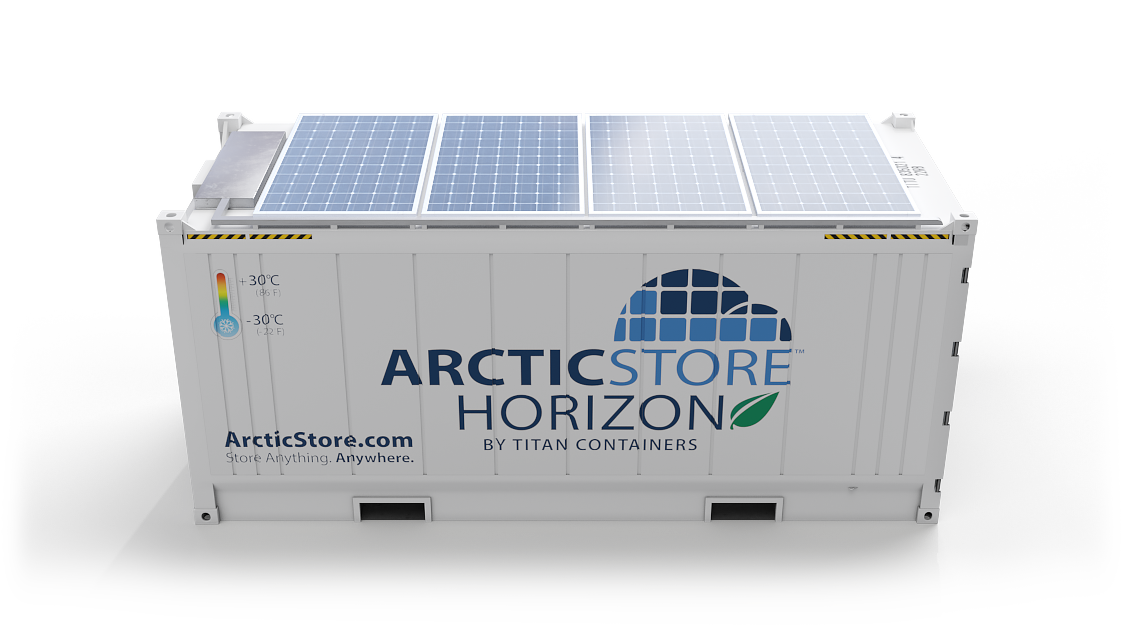
TITAN Container’s ArcticStore Horizon is its most energy-efficient containerized cold room, bringing advancements in insulation and solar power to help meet growing demand for flexible, energy-efficient storage.
By Kelley Rodriguez, Refrigerated & Frozen Foods
Published June 8th, 2026
As food manufacturers and logistics companies seek more flexible and energy-efficient ways to manage temperature-sensitive products, containerized cold rooms are emerging as an increasingly attractive alternative to traditional cold storage infrastructure.
Available in a range of temperature capabilities and footprints, containerized cold rooms support everything from short-term overflow storage to temperature-controlled production and distribution operations. Growing demand for fresh and minimally processed foods is driving adoption across food processing and manufacturing and 3PLs, looking for scalable refrigerated capacity without the expense and permanence of traditional facilities.
TITAN Containers is bringing ArcticStore Horizon, its next-generation containerized cold room, to market, designed to reduce energy consumption while providing a scalable alternative to conventional cold storage infrastructure.
The Denmark-based company, which operates in more than 90 countries, developed the solution in response to customer demand across the food, pharmaceutical and industrial sectors.
“With ArcticStore Horizon specifically, we’ve developed our most energy-efficient cold storage solution to date,” said Søren Skov Mogensen, CEO of TITAN Containers.
TITAN concentrated on two key areas, insulation and solar power. The company says the result is average energy savings of up to 55% compared to conventional refrigerated containers, a notable figure in an industry where energy expenses can account for as much as 70% of operating costs.
ArcticStore Horizon incorporates vacuum insulation panels (VIPs), which TITAN says reduce energy consumption by approximately 30% on their own. Units can also be equipped with roof-mounted solar panels to further lower energy use.
“If you go to the pharma cold chain and look at how they transport very high-end products, they do so in boxes with vacuum-based insulation because it’s the best in the world. We’ve taken that and used it to insulate the walls of a container,” Mogensen said. “We’ve lowered the roof of the container and added solar panels that can be tilted to get the most efficient use. On average, that adds another 25% reduction. Customers can offset a significant portion of their consumption, which means less exposure to volatile electricity prices and more predictable operating costs.”
Read the full story here.