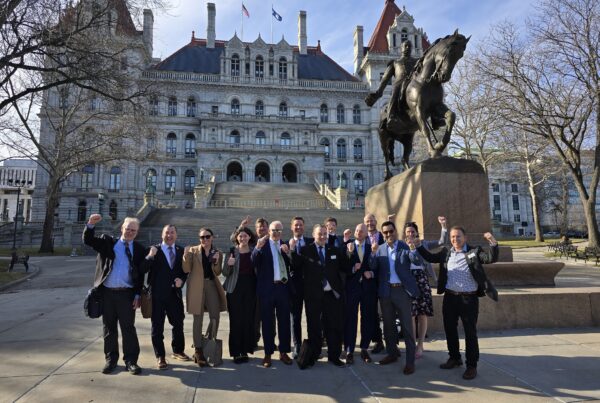
Sustainable PR’s founder, Tony DeFazio, speaks to why New York’s Climate Law must embrace distributed solar as the path to affordable clean energy.
A memo disclosed by the New York State Energy and Development Authority (NYSERDA) the last week of February claimed that if the state continues to comply with its climate law — the Climate Leadership and Community Protection Act (CLCPA) — New Yorkers relying on oil and natural gas may see their energy costs rise by as much as $4,000 a year.
The CLCPA isn’t to blame for these rising costs. The law was designed for an energy economy that no longer exists — one that predates the Trump administration’s rollback of Inflation Reduction Act investment tax credits, the rapid proliferation of AI data centers, and renewed turmoil in the Persian Gulf, all of which upended the law’s core assumptions. Nevertheless, many New Yorkers have latched onto the memo’s conclusions, pointing to their soaring electricity bills as evidence enough.
As the legislature and Governor debate whether to change the law, one critical point should not be overlooked: the phenomenal success of distributed solar generation, more commonly known as community solar.
Distributed solar generation surpassed the initial 6-GW milestone set by the CLCPA in 2024, both ahead of schedule and under budget. The target has since been expanded to 10-GW of generation by 2030, which the industry is not only on track to reach, but is pushing to expand based on the program’s success and its proven potential to reduce costs for residents.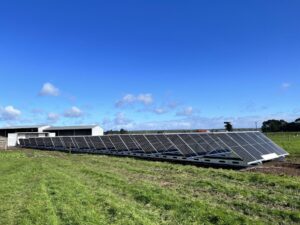
The Accelerate Solar for Affordable Power (ASAP) Act, proposed in February, would require New York to install 20 gigawatts of distributed solar energy by 2035 and modernize interconnection, expediting the integration of new distributed energy resources to the grid.
According to a study conducted by Synapse Energy Economics, the additional solar and storage capacity would generate nearly $1 billion of annual utility bill savings, double the size of the state’s solar and storage workforce, and protect ratepayers from gas price fluctuations. It’s a real solution to the energy affordability crisis — and one in which New York is uniquely positioned to deliver, having established itself as the leading community solar market in the U.S.
New York has an opportunity to revisit the progress the CLCPA has made thus far, and reissue updated mandates that take into account the volatile nature of the energy market of today as well as New York’s track record of success in distributed solar and storage. It’s an opportunity to course correct state policies to not just meet our climate goals, but to do so in a manner that does not jeopardize affordability.
To meet today’s economic, geopolitical, and technological realities, the executive branch and legislature must amend the CLCPA to incorporate the targets established by ASAP. New Yorkers who want real relief on their energy bills should call their legislators and urge them to support ASAP’s passage.
New York has led before on climate — the CLCPA itself is proof of that. The question now is whether the state can adapt that leadership to the moment and show that clean energy ambition and economic resilience were never in conflict.